A voice at the other end of the line: PNG’s 1-Tok Counselling Helpline
10 November 2026
•By Zoë Taylor

Your gift will make an impact.
Help shape a child's future today.
A Helpline. A Lifeline.
Somewhere in Papua New Guinea (PNG), right now, a phone is ringing. It might be a woman who isn't safe at home. A teenager who doesn't know who else to tell. A father or partner trying to change. Someone just needing to hear another voice say: I'm listening.
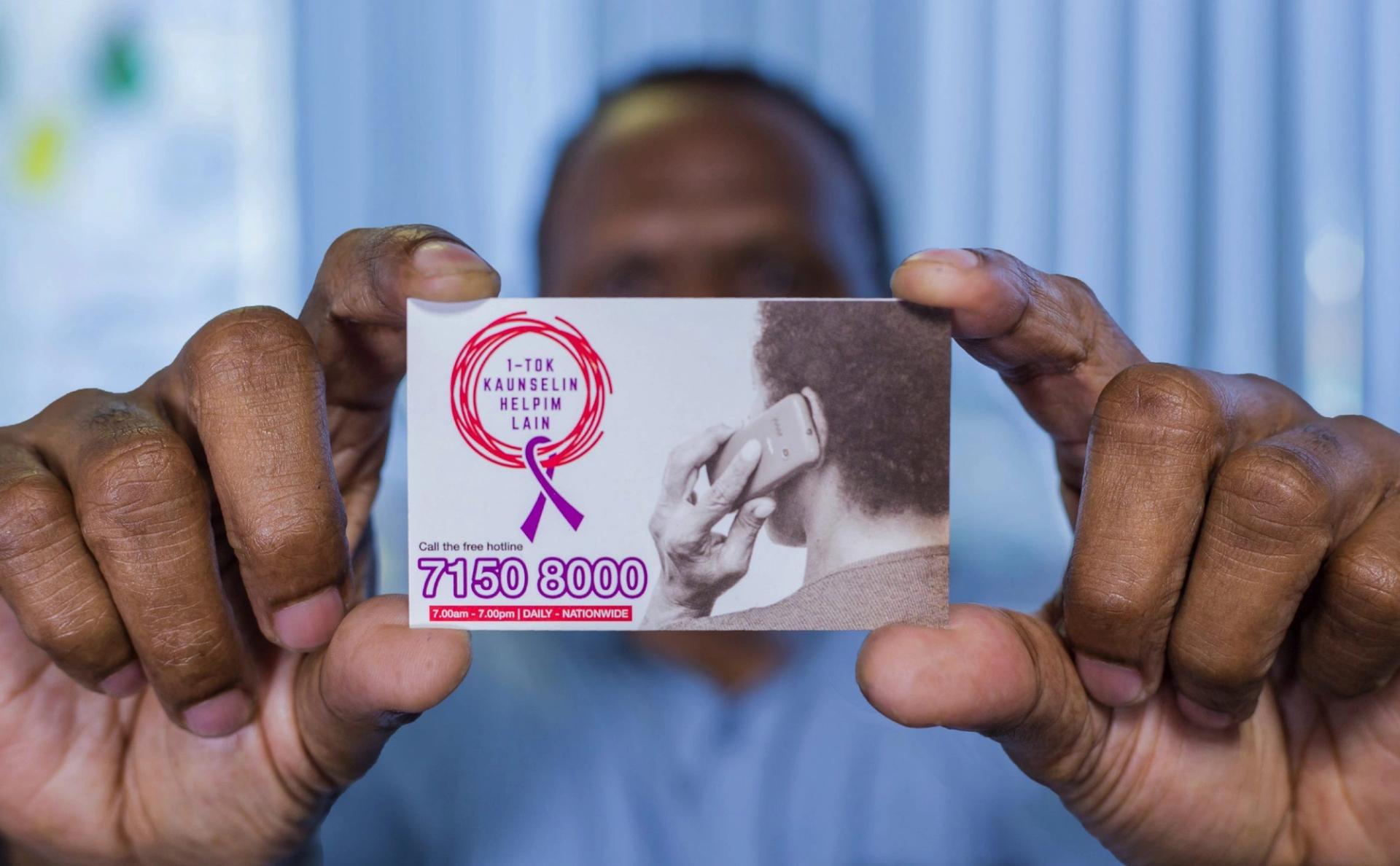
Whoever is calling, someone will answer, any time of day or night, in a language they understand in whichever of PNG's languages they speak. That's the simple promise behind the 1-Tok Counselling Helpline, the free, national telephone counselling service ChildFund PNG has run since 2015.
On the other end of the line is a trained counsellor, often partway through a long shift on a rotating roster – because violence doesn't keep office hours. For many callers, especially in rural communities where face-to-face support is hard to reach, theirs is the first steady voice they hear: someone ready to listen, help assess immediate risks, and connect them with the support available.
A first for PNG
Before the 1-Tok Counselling Helpline existed, there was no national service like it anywhere in PNG. For people in remote provinces – often hours or days from the nearest police station, clinic or support service – there was simply nowhere to call. In a country with some of the highest rates of gender-based violence in the world, and where many women and children outside the capital struggle to reach protection services of any kind, a phone line can be the only door open to them.
ChildFund PNG launched the helpline, together with CIMC-FSVAC, with funding from the New Zealand Ministry of Foreign Affairs and Trade (MFAT) and other partners. What began as a service staffed during business hours has grown steadily: since November 2020, it's answered calls 24 hours a day, 7 days a week
More than a phone number
The 1-Tok Counselling Helpline offers something critical: somewhere to talk, think, and be heard, without judgement and without pressure to act. A counsellor listens, helps a caller work out what they need, and – if they want it – offers information or a referral to local services: health, police, legal help, safe houses, child protection. Today, that referral network spans more than 350 service providers nationwide.
No one needs to have already decided what to do before they call. No one needs to name what's happened to them. The call is simply theirs to make, on their own terms.
Who picks up the phone – and who's on the other end of it
The helpline was built to offer survivor-centred counselling, information and referrals to children in need of care and protection, and to adolescent and adult survivors of gender-based violence. But in practice, it reaches far wider than that. Men make up a large share of callers, roughly 60 per cent between 2015 and 2023: some are survivors themselves, others are reaching out because they want to change their own behaviour.
It's also become a line people call in moments of acute crisis. After the devastating 2018 earthquake in Hela Province, more than 1,300 people rang the 1-Tok Counselling Helpline for counselling and support – a reminder that, in a disaster, emotional first aid matters as much as physical relief.
More than a decade of answering the phone
Since 2016, the 1-Tok Counselling Helpline has answered more than 80,000 calls. Calls have come in from all 22 of PNG's provinces, a reach that would have been unimaginable without a free, national phone line.
Numbers like these don't measure how common violence is in Papua New Guinea – they measure something else: how many people, when a free and confidential option finally existed, chose to reach for it.
Behind each of those calls is a counsellor. The calls are rarely easy. Some come from women who have suffered serious violence at the hands of a partner and need to be moved to safety within hours. Others come from adults breaking years – sometimes decades – of silence about abuse they suffered as children, reaching out for the first time to say what happened to them. Either way, the counsellor's task is the same: listen, believe, and respond quickly to what the caller needs.
That response can mean coordinating safe houses, transport, medical care or legal protection, sometimes against the clock. Reflecting on a case where a survivor was moved to a safe house just in time, one counsellor put it simply: “I believe we are playing a very meaningful part in the lives of Papua New Guineans throughout the country.”
It's demanding work, and the team carries it shift after shift. “Every day we are here working on a safe basis,” one counsellor says. “So, it's like our second home.” For another, the reward is in what the work makes possible: “I have that sense of satisfaction that I can provide that support for someone who's in a crisis situation.”
A line that's still growing
The 1-Tok Counselling Helpline was never meant to stay a single, static service. It's grown from business hours to 24/7, from a pilot to a nationwide line, and its referral network keeps expanding as more local services come on board.
That growth matters because safety shouldn't depend on where in PNG someone happens to live. A free call, answered any hour of the day, in a language someone actually speaks – that's a door that stays open, no matter how far someone is from the nearest service.
For the people who call, the message is unwavering: they are not alone, help is free, and support is available. As one counsellor puts it, “they can see that they're definitely getting the help or support that they need.”