
From dry season to harvest: Water conservation builds resilience in Timor-Leste
1 July 2026
•By Zoë Taylor

Building water resilience
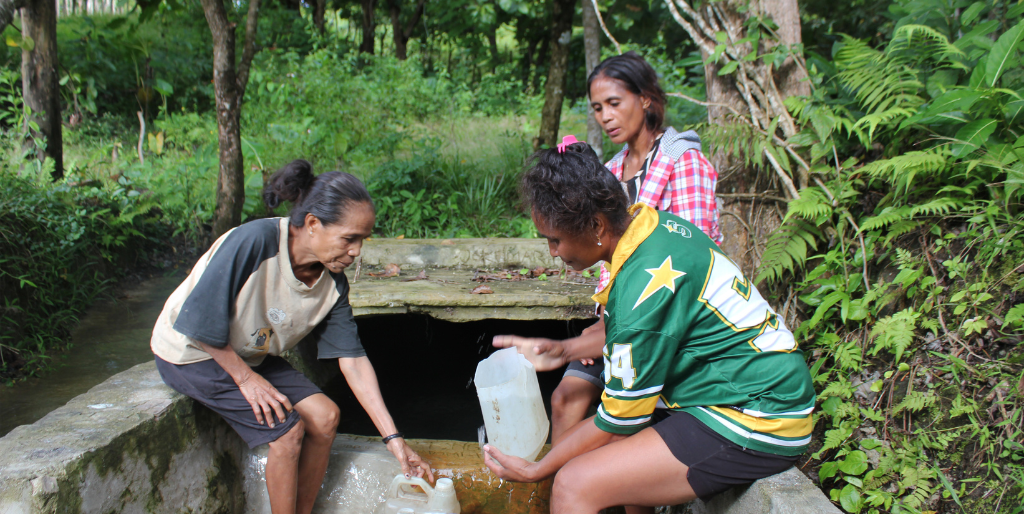
In remote communities on the eastern edge of Timor-Leste, the dry season arrives like a slow emergency. Wells drop. Rivers recede. The two-kilometre walk to fetch water begins again and for farming families, so does the grinding halt of everything that depends on it.
A community on the edge of drought
It is a pattern that leaves households, farmers, and families in a cycle of hardship that repeats year after year. For farmers like Alcina Pinto, a 29-year-old mother in Bauro, dry seasons meant farming came to a near standstill: “For many years, it has been difficult for us to carry out farming activities during the low-rainfall season because of limited water.”
Virginia Laurentina da Costa, a 56-year-old resident of Cacavei, described the burden this placed on daily life: “We have a natural well that we rely on, but during the dry season the water level drops and it becomes very difficult. Normally, we had to walk about 2 km to collect water for drinking, cooking, cleaning, feeding animals, and watering vegetables.”
Building a solution together
That cycle is changing thanks to the Disaster READY program communities in Bauro and Cacavei now harvest and store rainwater to see them through the dry months.
Supported by ChildFund Timor-Leste and Plan International Timor-Leste and delivered by local NGO Fraterna, the program is helping families to grow food, earn an income, and build a more secure future for their children.
Alongside the infrastructure is training: how to manage and maintain the ponds, how to extend the farming season, and how to make the most of what the wet season provides long after it ends.
The approach was grounded in what communities already knew about their land and their water. Fraternas’s role as implementing partner meant that the people building this solution were the same people who would live with it.
Key elements of the program included:
- Ten rainwater conservation ponds and 10 demonstration plots were constructed in 10 households in Bauro Village, enabling water storage for three to four months during the dry season.
- Construction of five water catchment ponds to collect and store rainwater and surface runoff in Cacavei Village.
- Training in water conservation practices and dry-season agricultural techniques
- Distribution of farming materials to support increased crop production
- Locally led implementation through Fraterna, strengthening civil society capacity for future disaster risk reduction.
Water, within reach
The most immediate change is the simplest one: the walk to the river is over. The well that used to run low every dry season – now holds. The conservation ponds have helped recharge the groundwater table, not just store surface water. The effect ripples through every part of daily life.
“One water conservation pond can be used for 3 to 4 months, and it is enough to help us get through the dry season when water is scarce,” said Alcina Pinto, who grows leafy greens, water spinach, balsam pears, and eggplants on her farm. After the harvest season, she uses some of the produce for her own consumption and sells the rest at the local market to earn income to support her family.
Through her passion for farming, she dreams of supporting her children’s education and helping them succeed in the future.
Stronger foundations for the future
Taken together, the changes in Bauro and Cacavei represent more than improved water access. They represent a community that has moved from reactive hardship to active preparedness – one that now has the tools, the knowledge, and the infrastructure to manage the dry season rather than simply endure it.
As climate change intensifies seasonal variability across the region, this kind of locally embedded resilience becomes more important, not less. The investment made here – in infrastructure, in skills, in local civil society – is an investment in communities that will face these pressures for decades to come.
ChildFund Australia acknowledges the support of the Australian Government and the implementation of the Disaster Risk Reduction by local partners partnership with Fraterna ONG. Together, we are helping local farmers improve water availability, strengthen agricultural production, and build resilience to climate change.