Behind the Impact: Doreen Fernando
29 October 2026
•By Emily Freedman

Behind the Impact.
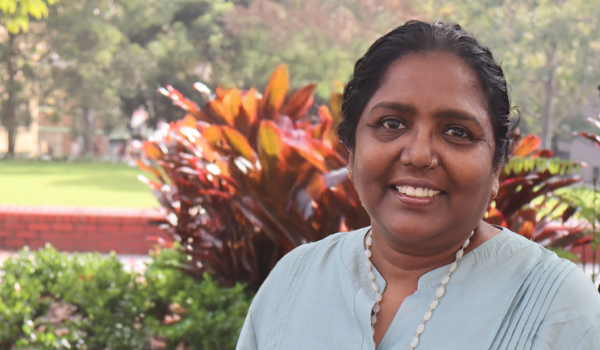
Creating real change for the children, families and communities ChildFund Australia supports doesn’t happen alone. It takes a team working across borders, timezones and challenges. Our Behind the Impact series gives you a closer look at what drives our team. Here, Doreen Fernando, Country Director of ChildFund Papua New Guinea, reflects on the experiences that shaped her, the lessons she continues to learn from communities and the unexpected hobby that helps her recharge.
Her father's influence
My father is my biggest inspiration. He was a social worker in Sri Lanka, working with plantation communities to build women’s leadership. When I was four or five, I went with him to workshops and watched him work with people. Those experiences influenced me, even before I understood what was happening.
I studied economics, sociology and accounting before starting my career at KPMG, a professional services and consulting firm. Wanting to contribute to society, I took an accounting role with an international development agency. After two or three years, I moved into community development to work more directly with people and communities.
I’ve always been curious about people, communities and institutions, particularly gender power dynamics and inequality, and how power sharing can drive positive change. International development has never just been a job. It’s what I want to spend my life doing.
What a report card leaves out
Before joining ChildFund, I’d worked with marginalised communities and on social justice and gender equality, but not specifically on child rights. This role was a new challenge and an opportunity to apply my experience in a different context.
One of the challenges is evaluating the children who need our help. We look at marks and scores, expecting every child to meet the same standard. But every child is different and capable of succeeding in their own way.
Spending time with children shows you what a report card leaves out: their interests, ideas and potential. We need to look beyond academic results and give children opportunities to develop their strengths and show what they can do.
The values that guide her work
One principle I try to live by is to be the change I want to see in others. I ask myself whether I practise the values I expect from others, particularly equality, justice, accountability, commitment and integrity. These values must shape how we work and make decisions. Reflecting on our own behaviour is especially important in leadership.
'Wantok'culture: looking out for one another
One thing I’ve come to appreciate about living and working in Papua New Guinea is how people look out for each other. Family and community relationships are important, and I often see this in the way people support their wantok.
Even when people have little, they share what they have, help care for children, support their education or step in when someone needs help. It has shown me that support isn’t always financial. Sometimes it’s simply about being there for someone. A child may be surrounded by extended family and other people who help care for them, guide them and support their education. That sense of caring for one another is something I’ve really come to value.
I see that same commitment to helping others in the 1-Tok Kaunselin Helpim Lain. We receive calls from people experiencing distress, trauma and violence. The people answering those calls do an amazing job helping callers navigate difficult situations, and I have great respect for them.
No child should be forgotten
I’ve met children whose schools are far from home, with too few teachers, limited learning resources, no drinking water or proper toilets, and overcrowded classrooms. These are everyday challenges for children in many remote communities across PNG. Yet they still want to learn, dream about their futures and have the same hopes as any other child.
At ChildFund, we work alongside education departments, school leaders and communities to improve learning environments. This includes helping schools plan improvements, make better use of resources and strengthen leadership and management. When we return to a community and see children attending school regularly, it’s really touching. We can see the difference a better learning environment makes to children and the hope it brings to parents. Moments like these remind me why this work matters.
Accessing health care can also mean long, costly journeys for families in rural and remote communities. We work alongside health workers to bring essential services closer to families, including vaccinations, maternal and reproductive health care and referrals when needed.
Why children can’t wait for systems to catch up
Strong public systems are essential to ensuring every child can access education, health care, safe water and protection. Strengthening these systems takes time, particularly in a country where many communities are remote and difficult to reach.
But childhood does not wait. Children grow, learn and develop every day. A missed opportunity to learn, an untreated illness or a lack of safe water can have lasting consequences. We need to respond to children’s needs today while working alongside communities, government and other partners to build stronger services for tomorrow. For me, it’s about making sure children aren’t forgotten simply because reaching them is difficult.
Finding her way back to the work
Being Country Director brings opportunities to support communities and make a difference, but it also comes with pressure and difficult days. When I feel down or overwhelmed, I try to plan a field visit. I sit with people, talk to them and listen to what’s happening in their lives. Seeing what our programs mean to people gives me an energy boost and reminds me why I chose this path. It’s these connections with children, families and communities that give me the motivation to keep going, even on the difficult days.
I’ve also taken up pottery. It’s a relatively new hobby, but it’s become a great way for me to switch off and focus on something outside work.
This interview has been edited and condensed for clarity.