

Can education reduce poverty?
15 December 2025
•By ChildFund Australia


Why education matters in reducing poverty
Every day, millions of children are denied the education they have a right to. Classrooms are overcrowded, textbooks are scarce and many children must care for siblings, work on family farms or support their communities instead of attending school. In rural and remote areas, and in regions affected by conflict, these barriers are even greater, leaving children without the tools to succeed.
Education isn’t just learning – it’s a lifeline that results in long-term community wellbeing, highlighting the role of education in poverty reduction. Providing children with quality education, practical skills and confidence doesn’t only benefit them individually; it improves health, boosts future earning potential and strengthens entire communities.
Can education reduce poverty?
According to the United Nations, poverty looks different in every country. For some, it’s a lack of money or possessions; for others, it’s limited access to essential services like healthcare, safe spaces or education. We see this firsthand in the countries where we work – poverty blocks millions of children from reaching their potential. While food, water and shelter are vital, education is the key that opens doors to a brighter future, showing clearly how education helps poverty decline across generations. It is a fundamental right and one of the most powerful ways to break the cycle of poverty.
Poverty can mean:
- a shortage of financial resources and possessions, or
- the lack of access to essential services such as healthcare, education and safe environments.
Whatever the definition, poverty and disadvantage limit the opportunities available to millions of children in developing communities. While aid in the form of food, water and shelter provides crucial support, education and poverty reduction are deeply interconnected, reinforcing the link between education and poverty worldwide. Access to education is one of the most effective ways to give children the tools to build a better future.
Education and poverty statistics
The data is clear – education changes lives. Here are some statistics that demonstrate the measurable education impact on poverty:
- World poverty could be cut in half if all adults completed secondary education (UNESCO)
- Children of educated mothers are 50% more likely to survive past age five (ChildFund Alliance)
- Education improves access to healthcare, nutrition and clean water, reducing preventable illness (WHO)
Every child in school should have the chance to learn, explore new worlds, build confidence and acquire lifelong skills. Access to education is more than attending class – it’s a gateway to better health, greater opportunities and a brighter future.
Children want to go to school
Children like Chenda*,12, in Cambodia want to learn – they see education as a path to better opportunities, safer communities and brighter futures. But their circumstances don’t always make it possible. Chenda (pictured below) was in Year 2 when she learned that her family couldn’t afford to keep her in school. Her parents went to neighbouring Thailand in search of work, and Chenda went to live with her grandfather.
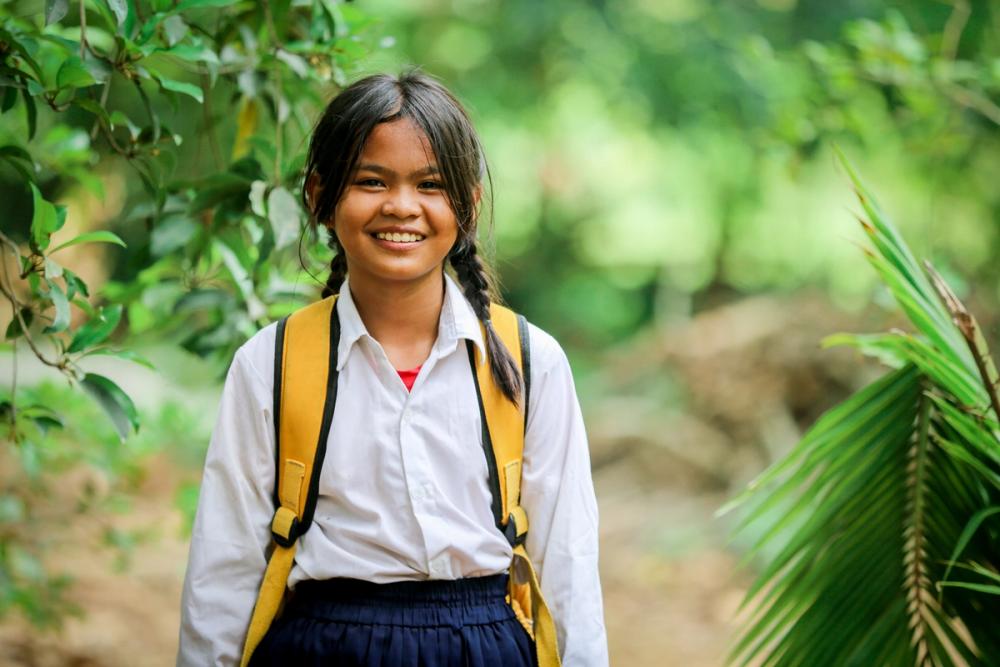
Instead of going to school, Chenda started to do chores at home instead to pass the time. “I wanted to go to school like other children,” Chenda said. “After doing housework, I had nothing to do. I was unhappy.”
Fortunately, Chena was able to go back to school. But millions of children around the world are still missing out on the education they need. This gap highlights ongoing global challenges around poverty and education, especially in rural or conflict-affected regions. According to the UNESCO Global Education Monitoring Report 2024, 251 million children and youth remain out of school, with the highest rates in low-income, rural and conflict-affected areas.
What is the Cycle of Poverty?
Education and poverty are closely connected; the link between education and poverty can determine a child’s lifelong opportunities. In vulnerable communities, children often leave school to help their families at home or contribute to household income. Without literacy and numeracy skills, they are limited to low-paying, unskilled work, which can keep families trapped in poverty.
Access to education helps poverty decline over time to break this cycle. By giving children the skills, knowledge and confidence to shape their own futures, it creates opportunities for families to move beyond disadvantage and build a better life for the next generation.
Find out more about how poverty impacts child development.
5 ways education can end poverty
Education opens doors to opportunity and helps break the cycle of disadvantage. Here’s how:
1. Improving gender equality
When girls stay in school, they don’t just learn – they gain the chance to shape their own futures. Education builds confidence, opens doors to new opportunities and helps girls make informed choices about their health, families and careers.
In some of the communities where ChildFund Australia works, girls face real barriers even before they reach primary school. In Timor-Leste, for example, participation in early childhood education remains low, putting many girls at a disadvantage from the very beginning of their learning journey, according to the Malala Fund’s 2024 Timor-Leste Girls’ Education Country Card. Social expectations, household responsibilities and limited access to learning resources can make it even harder for them to continue their education into primary and secondary school.
The World Health Organisation (WHO) Cambodia reports that in Cambodia, dropout rates are highest in rural areas, meaning that by lower-secondary age, a significant number of girls are already out of school.
ChildFund Australia’s programs help change this story by keeping girls in school and surrounding them with the support they need – from access to early learning activities to community awareness sessions that encourage families to prioritise girls’ education. When girls stay in school, they are more likely to earn an income, make informed decisions about health and family life and inspire positive change in their communities.
2. Increasing individual income
Every year a child stays in school can make a real difference for their future. In low- to middle-income countries, studies show that each additional year of education can increase an individual’s income by around 10%, and every dollar invested in schooling can return USD $2.50–$5 in earnings.
Our programs are helping to address this basic right and need for children and young people, especially for those living in remote and rural communities where access to the local school might be hours away by foot. For example, school supplies and computer literacy training help young people complete secondary school and learn practical skills they can enter the workforce.
Education opens the door to better employment, financial independence, economic stability and long-term opportunities, helping children break the cycle of poverty and contribute to stronger communities.
3. Literacy improves health
Education isn’t just about school – it can save lives and improve child health. When parents are literate, they can read vital health information during and after pregnancy, helping reduce maternal and child mortality. Understanding nutrition, hygiene, sanitation and disease prevention also lowers preventable illnesses, reduces medical costs and creates healthier families and stronger communities.
In the countries where ChildFund Australia works, literacy and health programs show how education directly improves wellbeing. In Vietnam, ChildFund runs health and wellbeing programs in schools that combine sexual and reproductive health education, sanitation, hygiene and life-skills training with basic literacy and school support. Students learn about puberty, menstrual hygiene, disease prevention and healthy relationships in a safe, supportive environment – giving them the knowledge and confidence to make informed decisions about their bodies and health.
ChildFund in Timor-Leste’s home garden and community agriculture programs have helped families grow nutritious food and earn steady incomes. A farmer named Americo was part of a group of 350 families learning sustainable farming techniques: composting, pest control, crop selection and water conservation. His garden now produces vegetables and legumes year-round. The extra food and income allow his children to eat healthy meals, attend school regularly and focus on learning instead of worrying about their next meal.
By linking literacy with practical health education, families and young people can make informed health choices. This leads to improved child survival, better hygiene and nutrition, fewer preventable illnesses, and overall stronger community wellbeing.
4. Strengthening communities
When children go to school and their families receive support, the benefits ripple far beyond the classroom. Education and community programs don’t just change individual lives – they transform entire communities.
In Timor-Leste, Americo’s family learned sustainable farming techniques through a ChildFund program. Their garden now produces enough nutritious food to eat and sell, and neighbours have started their own gardens, improving food security and livelihoods across the village.
Education programs also boost learning and confidence. 9-year-old Tomás (https://www.childfund.org.au/news-and-stories/child-literacy-timor-leste/) receives extra support through an after-school reading program, helping him build literacy skills that improve school engagement and open doors to future employment opportunities. In Cambodia and Vietnam, children facing similar learning challenges (https://www.childfund.org.au/news-and-stories/breaking-barriers-to-learning/) get literacy and numeracy support, helping them stay in school and pursue goals that once seemed out of reach.
A strong network of community support allows families to focus on education, health, and daily life. In Papua New Guinea, ChildFund’s child protection and community health programs work with volunteers and families so children can attend school, stay healthy and fully participate in their communities.
When children go to school, it doesn’t just change their lives – it strengthens communities. Families gain stability, children access more opportunities, and neighbours inspire one another to learn, grow and support each other.
5. Breaking the cycle across generations
Education doesn’t just change one child’s life – its impact ripples through families, communities, and future generations. The UNESCO & WHO 2024 report, Making Every School a Health-Promoting School: Global Standards and Indicators shows that children who complete school are more likely to find steady work, make informed health decisions, and contribute to household income. As they grow, they inspire younger siblings to stay in school and aim higher, while families adopt healthier habits around learning, nutrition and community participation.
ChildFund Australia’s programs support children and families with integrated initiatives in education, health, livelihoods and community development. This approach helps families break long-standing cycles of poverty, giving children the chance to learn, grow and access opportunities that strengthen households and communities. Over time, education doesn’t just transform one child’s life – it builds a foundation for future generations to achieve better health, stronger livelihoods and more resilient communities.
Help children in poverty to access an education
ChildFund offers a variety of ways for you to help children living in poverty to access education. For example, you can help by making regular donations or donating school supplies.
Together, we can open the doors to education for children who face the greatest barriers. Your support helps deliver school materials, strengthen classrooms and expand programs that bring quality learning to rural, remote and conflict-affected communities.
Every donation puts opportunity within reach and helps children build their own futures.